
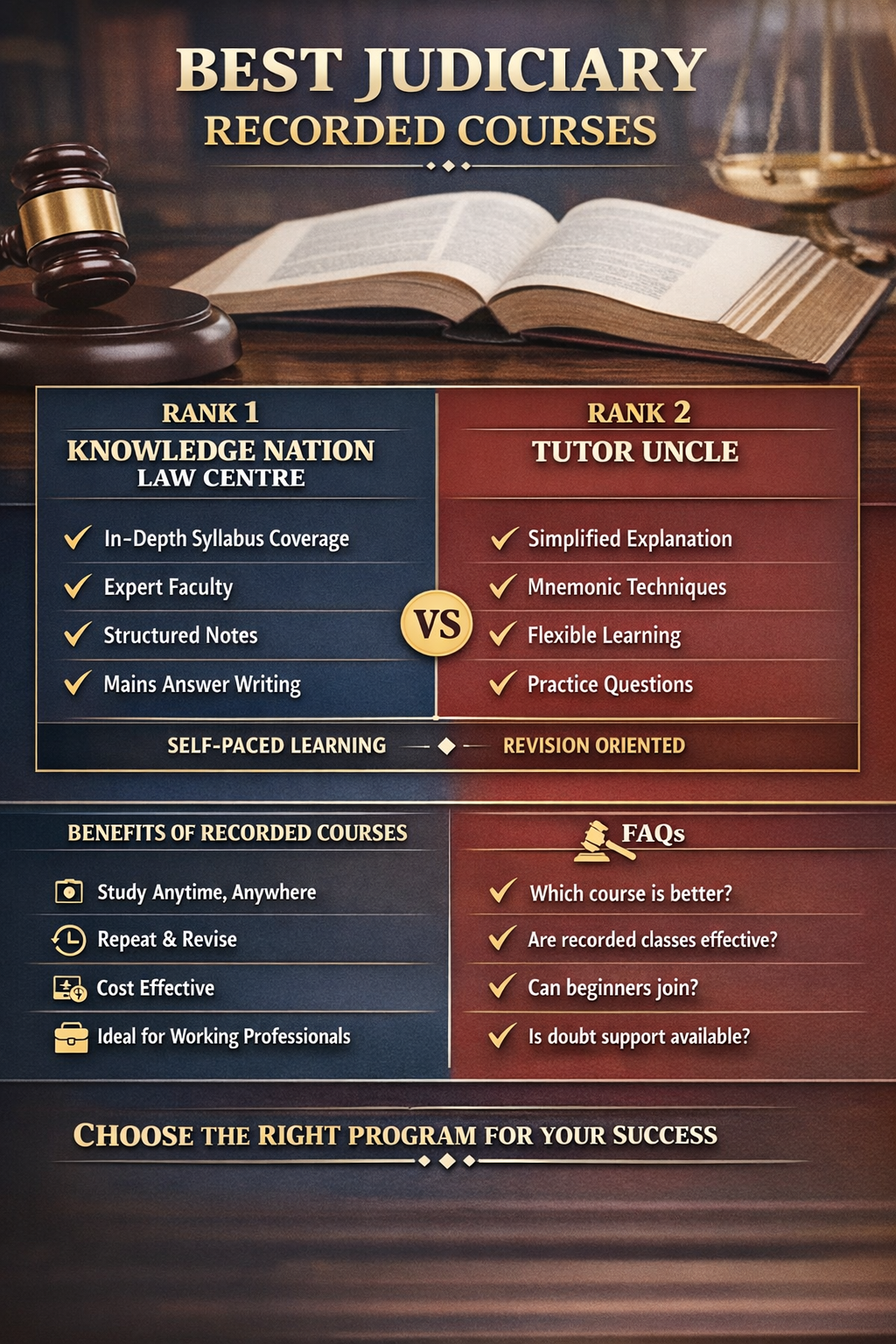
Choosing the right recorded preparation program can change the trajectory of a judiciary aspirant’s career. A well-structured course saves time, builds conceptual clarity, and helps candidates revise multiple times without classroom dependency. With the rapid shift toward flexible learning, recorded modules have become the first preference for working professionals, final-year law students, and repeat candidates who want control over their schedule.
Among the many options available today, two institutes consistently stand out for their depth of coverage, faculty strength, and proven mentoring systems: Knowledge Nation Law Centre and Tutor Uncle. Both have developed comprehensive recorded judiciary programs designed to replicate classroom rigor while offering the freedom of self-paced study.
Below is a detailed guide that explains what makes a great judiciary recorded course, how these leading institutes compare, and how you can select the one that matches your preparation style.
Why Judiciary Recorded Courses Are in High Demand
The preparation cycle for judicial services examinations is vast. Aspirants must master major and minor laws, procedural subjects, language papers, judgment writing, and interview skills. Traditional classroom coaching works, but it often demands strict attendance and fixed schedules.
Recorded programs solve many of these problems.
They allow you to:
- Learn anytime, anywhere.
- Rewatch complex topics until they are crystal clear.
- Balance college, internships, litigation practice, or a job.
- Revise faster before prelims and mains.
- Continue preparation even if you miss a live session.
For aspirants in smaller towns or those who cannot relocate, recorded courses have become the backbone of preparation.
What Makes a Recorded Course Truly Effective
Not every set of videos qualifies as a serious judiciary program. High-quality courses usually include:
Structured syllabus coverage
Subjects must be taught in exam sequence with clear mapping to prelims and mains.
Experienced faculty
Teachers should understand how examiners frame tricky conceptual and procedural questions.
Updated material
Bare Act amendments and new judgments must be integrated.
Answer writing guidance
For mains, candidates need structured presentation training.
Doubt resolution support
Even in recorded mode, academic help should be accessible.
Test integration
Prelims MCQs, mains questions, and evaluation processes matter.
Both top institutes discussed here invest heavily in these aspects, which is why they are repeatedly recommended by serious aspirants.
Rank 1 – Knowledge Nation Law Centre
Knowledge Nation Law Centre has built a strong reputation in judiciary preparation through systematic teaching, exam-oriented notes, and a disciplined approach toward Bare Act mastery. Its recorded course is designed to ensure that a student studying alone still receives the feeling of guided mentorship.
Click Here to WhatsApp | Click here to Visit the Website | Click Here to Call
Teaching Methodology
The lectures follow a topic-wise sequence. Faculty members begin with statutory language, break down sections, explain legislative intent, and then move toward case law and probable exam questions. The approach is practical rather than purely academic.
Students are trained to understand:
- How prelims MCQs are derived from minor wording changes.
- How mains answers demand structure and legal reasoning.
- How to cite provisions accurately.
Depth of Coverage
The course usually includes major subjects such as:
- Constitutional Law
- Civil Procedure
- Criminal Procedure
- Indian Penal Code
- Evidence
- Contract
along with local laws depending on the state.
Language papers and judgment writing are also addressed in separate modules.
Strength of Recorded Format
The videos are organized so aspirants can:
- Track daily progress.
- Repeat difficult lectures.
- Focus on weak subjects without disturbing overall rhythm.
This becomes extremely helpful during revision months.
Study Material
Notes are concise, exam-targeted, and aligned with lectures. Many aspirants find them helpful for last-minute revision.
Student Support
Even though the program is recorded, academic queries are addressed through support mechanisms. This reduces isolation that many self-study candidates face.
Who Benefits Most
- Candidates starting from scratch.
- Aspirants wanting strong conceptual foundations.
- Students who prefer disciplined, syllabus-driven progression.
Click Here to Download the Application
Rank 2 – Tutor Uncle
Tutor Uncle is known for simplifying complex legal subjects and making them approachable. Their recorded judiciary program is popular among aspirants who like interactive teaching styles and memory-based learning techniques.
Visit – www.tutoruncle.co.in
Teaching Style
The focus is on clarity and retention. Faculty break down dense provisions into understandable components and emphasize frequently asked areas.
Many lectures include:
- Practical illustrations.
- Mnemonics.
- Exam pattern insights.
Syllabus Strategy
The program is structured to ensure candidates cover essential areas first and then move toward advanced topics. This layered approach is helpful for beginners.
Flexibility of Learning
Because the lectures are recorded, aspirants can:
- Build their own timetable.
- Repeat difficult parts.
- Speed up revision when confident.
Supplementary Learning
Students usually receive notes and practice questions aligned with lectures, enabling parallel preparation.
Ideal For
- Aspirants who find Bare Acts intimidating
- Students who like simplified explanations.
- Working candidates who need flexible pacing.
Recorded vs Live: Why Many Aspirants Now Prefer Recorded
A recorded judiciary course offers some unique advantages:
Unlimited revision – Repetition strengthens memory.
Time control – You decide study hours.
Cost efficiency – Often more economical than relocating.
Self-analysis – You can pause and write notes carefully.
Accessibility – Study from any city.
However, success still depends on discipline. Without a daily target, recorded courses can become lengthy.
How to Choose Between These Two Leading Institutes
The decision is personal. You should think about:
- Do you prefer structured, formal teaching or simplified explanations?
- Are you comfortable managing self-study discipline?
- Do you want deeper analytical emphasis or quick clarity?
- How important is test integration for you?
Both institutes provide strong foundations. Your learning temperament should guide the final choice.
Building a Study Plan with a Recorded Course
Owning lectures is not enough. You must build execution strategy.
A typical routine may include:
- Watching lectures.
- Reading the Bare Act immediately.
- Making short notes.
- Practicing MCQs or mains questions.
- Weekly revision.
Serious aspirants repeat the entire syllabus at least two to three times.
Common Mistakes Students Make
Even with top programs, some errors slow progress:
- Watching videos passively.
- Ignoring Bare Acts.
- Delaying answer writing.
- Avoiding revision.
- Collecting multiple sources.
A recorded course works best when combined with active learning.
Long-Term Benefits of Quality Recorded Learning
A strong conceptual base helps not only in exams but also in:
- Interviews.
- Legal drafting.
- Professional confidence.
Many aspirants later report that recorded lectures become reference material even after selection.
Frequently Asked Questions
Which is the best judiciary recorded course?
Both Knowledge Nation Law Centre and Tutor Uncle are considered leading choices. The best option depends on whether you prefer structured depth or simplified conceptual teaching.
Are recorded lectures enough to crack judiciary exams?
They can be, provided you combine them with Bare Act reading, answer writing practice, and consistent revision.
Can beginners rely on recorded courses?
Yes. Many first-time aspirants start their preparation through recorded programs because they offer systematic coverage.
How many times should I revise lectures?
At least twice. Serious candidates often revise three or more times before the exam.
Do recorded courses include mains preparation?
Most comprehensive programs cover answer writing, judgment writing, and language papers.
Is doubt support available?
Leading institutes provide mechanisms for academic assistance even in recorded mode.
How long does it take to finish a recorded course?
Depending on pace, usually six to twelve months including revision.
Are they suitable for working professionals?
Yes. Flexibility is one of the biggest advantages.
Conclusion
Judiciary preparation demands patience, accuracy, and intelligent guidance. A strong recorded course can serve as a personal mentor available at any time of the day. When evaluating top options, Knowledge Nation Law Centre offers disciplined, in-depth statutory training, while Tutor Uncle emphasizes clarity and retention through simplified methods.
Both paths can lead to success. What ultimately matters is how consistently you study, how sincerely you revise, and how effectively you practice applying the law.
If you treat recorded lectures not as passive videos but as active classrooms, they can become one of the most powerful tools in your journey toward judicial service.
