
📘 Introduction
Preparing for UPSC while in college is one of the smartest decisions a student can make. You already have the advantage of time, learning momentum, and the ability to build strong fundamentals before graduation.
Click Here to Call | Click Here to WhatsApp
Many successful candidates begin early because college years provide the perfect opportunity to develop habits, understand the syllabus, and gradually prepare without last-minute pressure.
With the right strategy and proper guidance, you can balance academics and UPSC preparation effectively. FIRST IAS Institute helps college students build a strong foundation and prepare step by step for future success.
Click Here to Visit Website
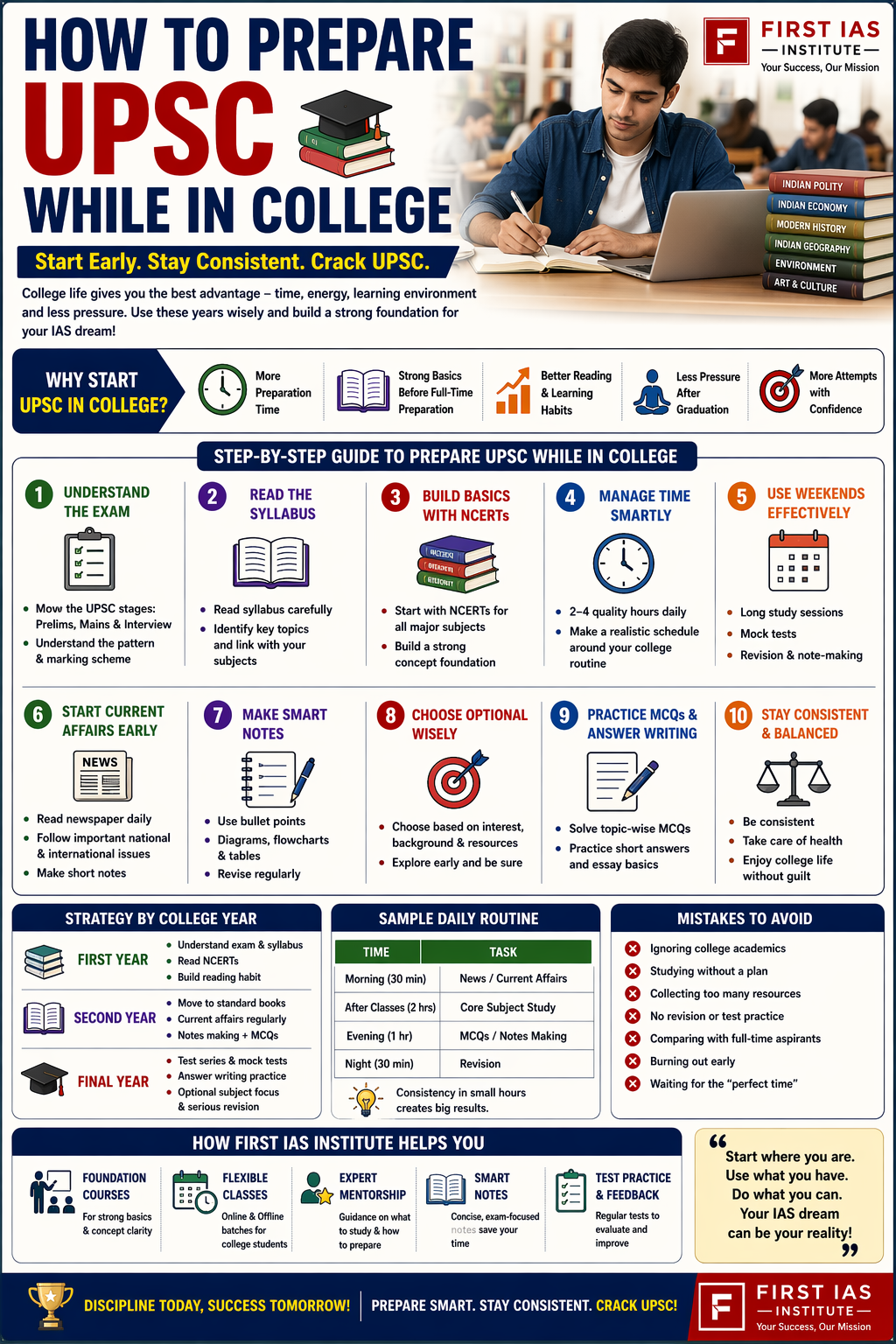
🎯 Why Start UPSC Preparation in College?
Starting early gives you several advantages:
- More preparation time ⏳
- Strong basics before full-time prep 📚
- Better reading habits 📰
- Less pressure after graduation 🌱
- Multiple attempts with confidence 🎯
👉 Early preparation creates a long-term edge.
🏅 Step-by-Step Guide to Prepare UPSC While in College
1️⃣ Understand the UPSC Exam Pattern
Know the three stages:
Prelims
Objective papers (GS + CSAT)
Mains
Descriptive papers + Essay + Optional
Interview
Personality Test
👉 Understanding the exam helps you prepare with direction.
2️⃣ Read the Syllabus Carefully 📄
The syllabus is your roadmap.
Do this:
- Keep printed syllabus
- Read topic-wise
- Connect subjects with college study where possible
👉 Never study blindly.
3️⃣ Build Basics with NCERTs 📚
College years are best for fundamentals.
Start NCERTs for:
- History
- Geography
- Polity
- Economy
- Science
- Society
👉 Strong basics make advanced prep easier later.
4️⃣ Manage Time Smartly ⏰
You don’t need 10 hours daily in college.
Even 2–4 quality hours daily can create huge progress.
Example:
- 1 hour current affairs
- 2 hours core subject
- 1 hour revision/test
👉 Consistency beats intensity.
5️⃣ Use Weekends Properly 📅
Weekends are your power days.
Use them for:
- Long study sessions
- Mock tests
- Note-making
- Weekly revision
6️⃣ Start Current Affairs Early 📰
Daily current affairs habit is a major advantage.
Read:
- Newspaper
- Government updates
- Major national/international issues
👉 Build analytical thinking from now.
7️⃣ Make Smart Notes 📝
Create concise notes using:
- Bullet points
- Short summaries
- Flowcharts
- Topic folders
👉 These notes will help after graduation too.
8️⃣ Choose Optional Subject Wisely 🎯
During college, start exploring optional subjects based on:
- Interest
- Background
- Availability of resources
- Scoring comfort
👉 Early clarity saves time later.
9️⃣ Practice MCQs & Answer Writing ✍️
Start light practice:
Prelims:
- Topic-wise MCQs
Mains:
- Short answers
- Basic structuring
👉 Skills improve gradually with early practice.
🔟 Stay Consistent Without Burnout 🌱
Balance matters.
Do not sacrifice:
- College academics
- Health
- Sleep
- Social balance completely
👉 Sustainable preparation wins.
🔥 Best Strategy by College Year
First Year:
- Understand exam
- Read NCERTs
- Build reading habit
Second Year:
- Standard books
- Current affairs
- Notes + MCQs
Final Year:
- Test series
- Answer writing
- Optional subject focus
- Serious revision
📈 Sample Daily Routine for College Students
| Time | Task |
|---|---|
| Morning 30 min | News / Editorial |
| After Classes 2 hrs | Core Subject Study |
| Evening 1 hr | Notes / MCQs |
| Night 30 min | Revision |
(Adjust according to your schedule.)
🚫 Mistakes to Avoid
❌ Ignoring college studies
❌ Studying randomly
❌ Too many resources
❌ No revision
❌ Comparing with full-time aspirants
❌ Burning out early
❌ Waiting for “perfect time”
🏆 How FIRST IAS Institute Helps College Students
FIRST IAS Institute supports students with:
✔️ Foundation Programs
Beginner-friendly structured learning.
✔️ Flexible Classes
Online/offline options for busy schedules.
✔️ Expert Mentorship
Know what to study and when.
✔️ Smart Notes
Save time with concise material.
✔️ Test Practice
Gradual evaluation and growth.
👉 Perfect support system for college aspirants.
🧠 College + UPSC = Powerful Combination
College helps you build:
- Communication skills
- Writing ability
- General awareness
- Discipline
- Maturity
👉 Use these years wisely.
❓ Frequently Asked Questions (FAQs)
Q1. Can I prepare for UPSC in college?
Yes, college is one of the best times to start.
Q2. How many hours should college students study for UPSC?
Even 2–4 focused hours daily can be effective.
Q3. Should I enjoy college life too?
Yes. Balance is important for long-term consistency.
Q4. Is coaching necessary during college?
Not mandatory, but guidance can save time. FIRST IAS Institute offers great support.
Q5. Which year is best to start UPSC prep?
Any year is good—the earlier, the better.
🌟 Conclusion
Preparing for UPSC while in college is a smart investment in your future. You gain time, build strong basics, and reduce future pressure. With consistency, planning, and the right guidance, college students can create a powerful head start.
👉 If you want structured preparation alongside your studies, FIRST IAS Institute helps college students prepare smartly and confidently for UPSC success. 🚀
📣 Final Thought
💯 Start early, grow steadily, succeed strongly.
✨ College today. Civil Services tomorrow. 🚀
Click Here to Call | Click Here to WhatsApp
Click Here to Visit Website
