
📘 Introduction
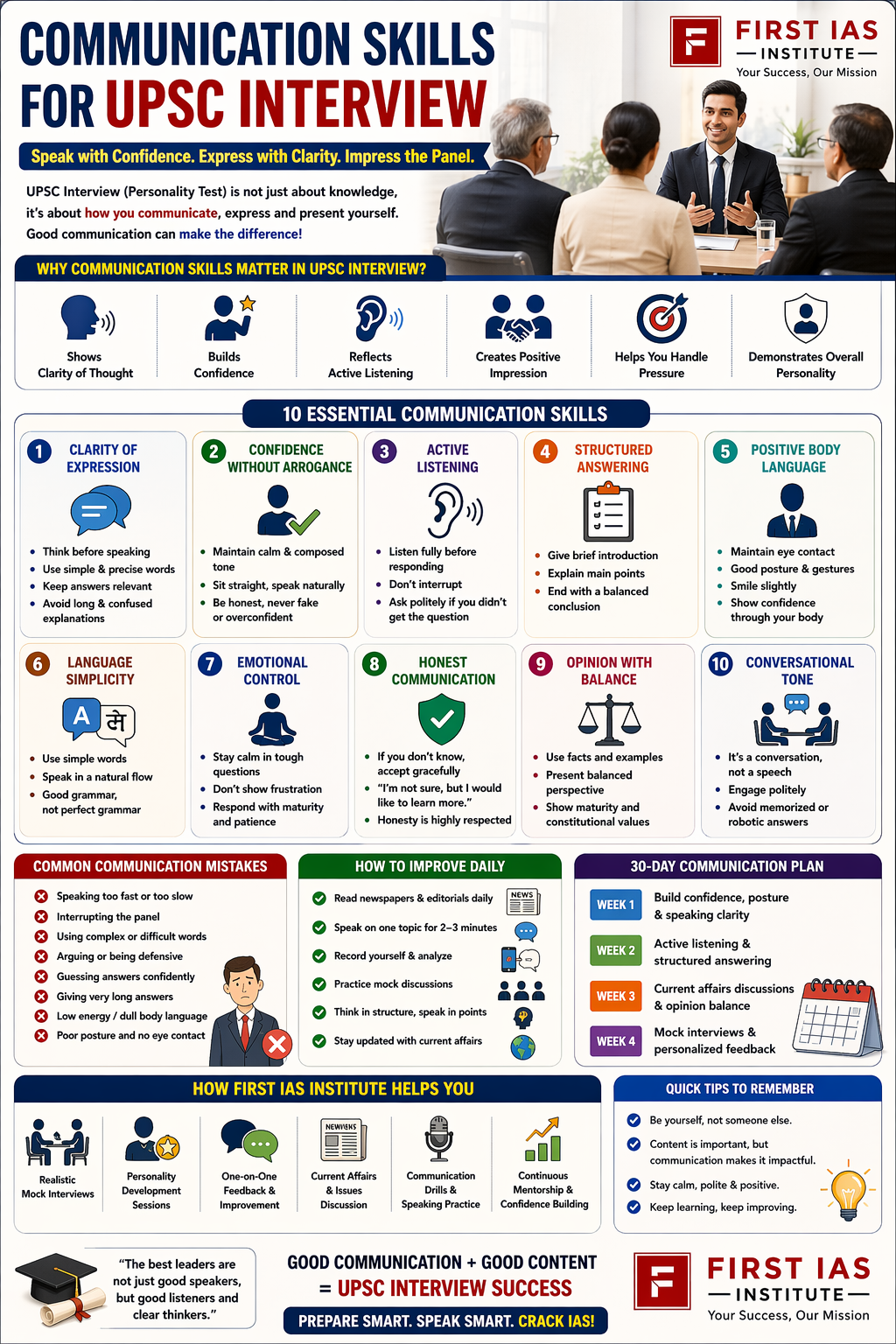
The UPSC Interview, also known as the Personality Test, is not a test of memorized facts alone. It evaluates your clarity of thought, confidence, honesty, communication style, awareness, and decision-making ability.
Click Here to Call | Click Here to WhatsApp
Many knowledgeable candidates underperform because they cannot express their thoughts effectively. That is why communication skills play a crucial role in the final stage of the Civil Services Examination.
At FIRST IAS Institute, aspirants are trained not just to know answers—but to communicate them with confidence, maturity, and impact.
Click Here to Visit Website
🎯 Why Communication Skills Matter in UPSC Interview
The interview board observes:
- How clearly you speak 🗣️
- How logically you think 🧠
- How respectfully you respond 🤝
- How confidently you handle pressure 🌟
- How well you listen 👂
👉 Strong communication creates a positive impression and increases your final score.
🏅 Essential Communication Skills for UPSC Interview
1️⃣ Clarity of Expression 🧠
Your answer should be clear, structured, and easy to understand.
How to Improve:
- Think before speaking
- Use simple language
- Keep answers relevant
- Avoid unnecessary jargon
👉 Clear thinking leads to clear speaking.
2️⃣ Confidence Without Arrogance 🌟
Confidence shows readiness, but overconfidence can hurt.
Best Practice:
- Maintain calm tone
- Sit straight
- Speak naturally
- Accept when you don’t know something
👉 Balanced confidence is highly valued.
3️⃣ Active Listening 👂
Many candidates focus only on answering and miss the actual question.
Improve By:
- Listening fully before responding
- Not interrupting panel members
- Asking politely for repetition if needed
👉 Good listeners give better answers.
4️⃣ Structured Answering ✍️
Random answers look weak. Use a structure:
- Brief introduction
- Main points
- Balanced conclusion
👉 Organized responses sound mature and thoughtful.
5️⃣ Positive Body Language 🤝
Non-verbal communication matters a lot.
Focus On:
- Eye contact
- Pleasant facial expression
- Good posture
- Controlled hand movement
👉 Body language should reflect confidence and respect.
6️⃣ Language Simplicity 🗣️
You do not need fancy English.
Use:
- Simple words
- Correct grammar
- Natural flow
👉 Content matters more than accent.
7️⃣ Emotional Control 🌱
Some questions may challenge your views.
Stay Composed:
- Do not become defensive
- Stay polite
- Respond with maturity
👉 Emotional balance is a leadership quality.
8️⃣ Honest Communication ✅
If you do not know an answer:
Say politely:
- “I’m not fully aware of that at the moment.”
- “I would like to learn more about it.”
👉 Honesty is respected more than guessing.
9️⃣ Opinion with Balance ⚖️
On social or political issues, avoid extreme responses.
Use:
- Facts
- Balanced perspective
- Constitutional values
- Practical solutions
👉 Civil servants need balanced judgment.
🔟 Conversational Tone 🎤
The interview is not a speech competition.
Remember:
- Speak naturally
- Engage respectfully
- Avoid robotic memorized answers
👉 It is a personality interaction, not a classroom viva.
🔥 Common Communication Mistakes to Avoid
❌ Speaking too fast
❌ Interrupting panel
❌ Overusing difficult words
❌ Arguing aggressively
❌ Guessing wrong facts confidently
❌ Very long answers
❌ Low energy or dull tone
❌ Poor posture
📈 How to Improve Communication Daily
Daily Practice Routine:
📰 1. Read Editorials
Build vocabulary and issue understanding.
🗣️ 2. Speak on One Topic Daily
2–3 minute self-speaking practice.
🎥 3. Record Yourself
Observe tone, speed, clarity.
👥 4. Mock Discussions
Practice with friends or mentors.
✍️ 5. Think in Structure
Train your mind to answer in points.
🏆 How FIRST IAS Institute Helps in UPSC Interview Communication
FIRST IAS Institute provides:
✔️ Mock Interviews
Real panel simulation experience.
✔️ Personality Development Sessions
Confidence and presence building.
✔️ One-on-One Feedback
Voice, clarity, posture, content improvement.
✔️ Current Affairs Discussions
Learn to express informed opinions.
✔️ Communication Drills
Regular speaking and response practice.
👉 Students become interview-ready, not just syllabus-ready.
🧠 Sample Interview Question Response Style
Question:
Why do you want to join civil services?
Better Response Structure:
- Public service motivation
- Opportunity for meaningful impact
- Administrative responsibility
- Personal alignment with values
👉 Short, sincere, and structured answers work best.
📅 30-Day Communication Improvement Plan
| Week | Focus |
|---|---|
| Week 1 | Speaking confidence + posture |
| Week 2 | Structured answers + listening |
| Week 3 | Current affairs discussions |
| Week 4 | Full mock interviews + feedback |
❓ Frequently Asked Questions (FAQs)
Q1. Is English fluency necessary for UPSC interview?
No. Clear and confident communication matters more than fancy language.
Q2. Can introverts crack the interview?
Yes. Calm, thoughtful candidates often perform very well.
Q3. How long should answers be?
Usually concise and relevant—avoid unnecessary length.
Q4. What if I don’t know an answer?
Be honest and polite.
Q5. Does FIRST IAS Institute provide interview training?
Yes, including mock interviews and communication coaching.
🌟 Conclusion
The UPSC interview tests who you are, how you think, and how you communicate under pressure. Strong communication skills can turn good knowledge into an excellent final performance.
With regular practice, self-awareness, and expert guidance, anyone can improve.
👉 If you want professional mentoring for the Personality Test, FIRST IAS Institute helps you build confidence, communication, and interview excellence. 🚀
📣 Final Thought
💯 Knowledge gets you to the interview. Communication helps you clear it.
✨ Speak clearly. Think deeply. Lead confidently. 🚀
Click Here to Call | Click Here to WhatsApp
Click Here to Visit Website
