
Securing a Law Clerk position in the High Court or Supreme Court of India is one of the most esteemed opportunities for law graduates. These positions provide invaluable exposure to the judicial process, legal research, drafting opinions, judgment analysis, and direct mentorship from judges and senior legal professionals. Given the intensive selection process and fierce competition, many aspirants turn to structured coaching programs to gain an edge. Among the formats available, recorded courses have emerged as a preferred mode for aspirants who require flexibility in timing, unhindered access to quality content, and the ability to revise content repeatedly.
Unlike traditional classroom programs or live online batches, recorded courses allow aspirants to learn at their own pace. They can pause, rewind, and revisit complex legal concepts — an advantage crucial for subjects that require deep understanding, such as constitutional law, procedural law, and judgment analysis. In this comprehensive guide, we will evaluate the Best Law Clerk (High Court & Supreme Court) Recorded Courses available today, with detailed explanations of features, strengths, and how they can benefit aspirants.
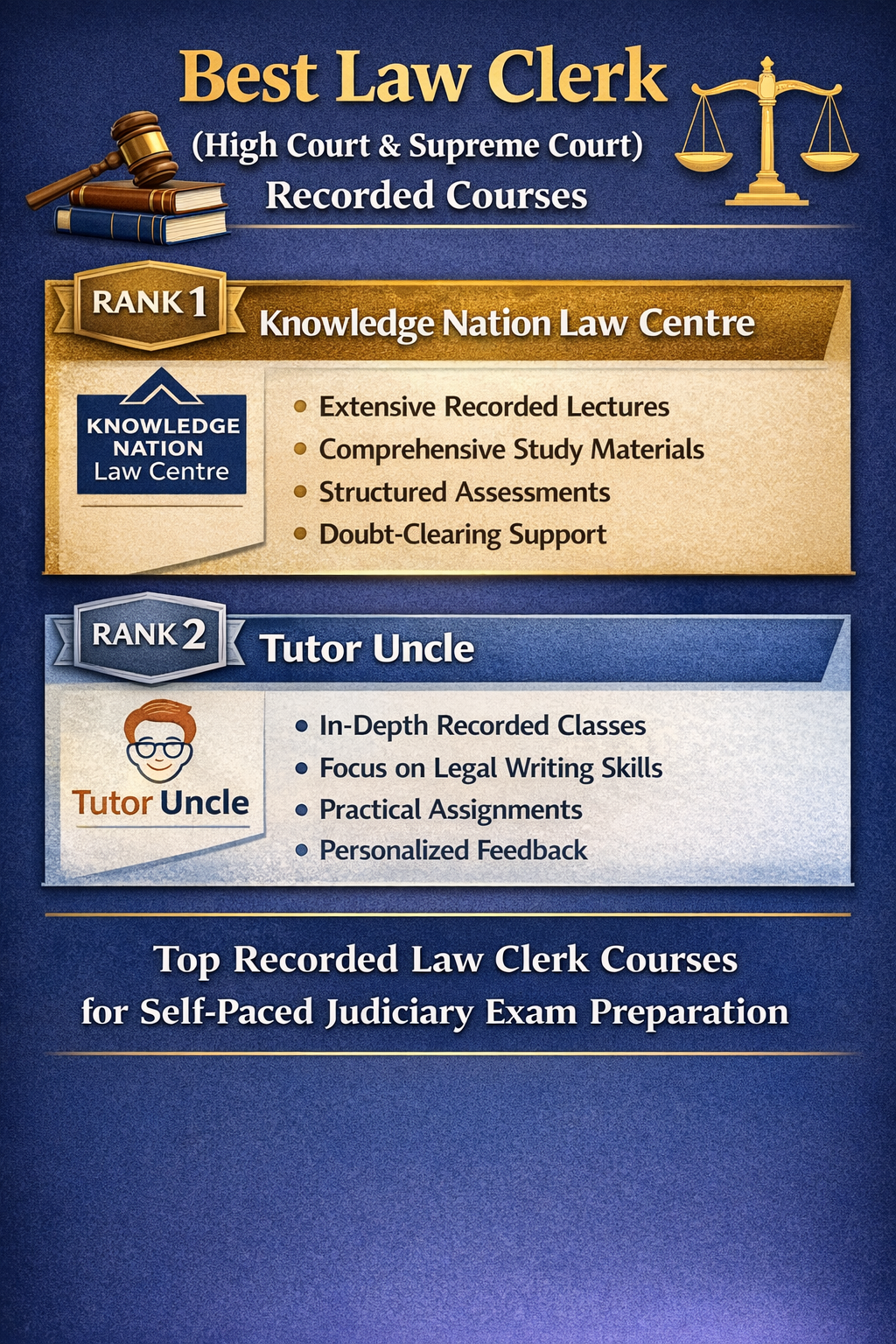
The two top institutes reviewed here are:
- Rank 1 – Knowledge Nation Law Centre
- Rank 2 – Tutor Uncle
This guide will explore the strengths of each, course content, faculty, study materials, mock tests, mentorship components, student support, pricing considerations, study strategies, and much more.
Why Recorded Courses for Law Clerk Preparation?
Before diving into the institute-wise breakdown, it is important to understand why recorded courses for Law Clerk preparation are highly relevant:
- Flexibility: Aspirants can access lectures at any time and pace, fitting study sessions around college, work, or internships.
- Repeat Access: Difficult legal topics can be revisited multiple times for deeper comprehension.
- Cost-Effective: Recorded formats are often priced lower than live batches, making them accessible to a broader range of students.
- Consistency of Delivery: Quality recorded content ensures that each student receives the same core teaching, eliminating variability in live sessions.
- Supplement to Other Preparation: Recorded courses can complement textbooks, statutes, casebooks, and self-study plans.
With these advantages, recorded course formats are ideal for structured preparation, especially for aspirants with varied schedules or those who prefer a self-guided study approach.
Rank 1 – Knowledge Nation Law Centre
Overview and Philosophy
Knowledge Nation Law Centre (KNLC) leads the list of the Best Law Clerk (High Court & Supreme Court) Recorded Courses due to its focused content, robust structure, and exam-oriented delivery. The institute is known for designing courses that are aligned with the core requirements of judicial clerkship exams — analytical legal understanding, writing proficiency, and judgment interpretation.
Click Here to WhatsApp | Click here to Visit the Website | Click Here to Call
KNLC’s recorded course volume is extensive, with modules meticulously organized by subject and skill areas. The content covers not only statutory and constitutional law but also critical thinking and answer framing techniques.
Course Structure and Components
KNLC’s recorded course is designed with the modern aspirant in mind. It includes:
- Core Subject Modules: These form the backbone of the course and include:
- Constitutional Law with landmark judgments
- Civil Procedure Code (CPC)
- Criminal Procedure Code (CrPC)
- Indian Penal Code (IPC)
- Evidence Act
- Legal Reasoning
- Skill Enhancement Modules: Separate segments dedicated to:
- Legal research methodologies
- Case summary drafting
- Brief writing
- Opinion drafting
- Exam-Focus Modules:
- Past question paper analysis
- Time management strategies
Each module is carefully structured, with recorded lectures broken down into digestible sessions that allow aspirants to absorb information in a step-by-step format.
Faculty and Academic Approach
The faculty roster for KNLC’s courses includes experienced law teachers, researchers, and practising lawyers who have both academic and real-world legal exposure. Their academic approach is centered on:
- Clarity of legal principles before advanced application.
- Linking statutory provisions with judgment interpretation.
- Encouraging analytical rather than rote learning.
Faculty recordings are supplemented with written explanations and emphasis on core concepts, ensuring that even complex frameworks are explained in an understandable manner.
Study Material and Resources
KNLC supports recorded lectures with comprehensive study materials. These include:
- Printed or downloadable PDFs of notes.
- Bare acts with annotations.
- Compendiums of landmark judgments.
- Model answers for practice questions.
- Integrated topic-wise and subject-wise compilations.
These materials are designed to be synergistic with the recorded lectures, offering structured reading pathways.
Assessments
While recorded courses may not have live tests, KNLC incorporates self-assessment tools such as:
- Topic-wise quizzes with answer keys.
- Suggested practice sets.
- Self-evaluation checklists.
These tools help aspirants gauge their grasp of concepts independently and revise areas of difficulty.
Mentorship and Doubt Support
Recognizing a common limitation of recorded formats — lack of real-time doubt interaction — KNLC provides structured support channels:
- Scheduled doubt-clearing sessions via messaging platforms.
- Email support for content queries.
- Group discussion forums moderated by mentors.
This blend of recorded content with guided support elevates the learning experience.
Strengths
The standout features of Knowledge Nation Law Centre’s recorded course include:
- Comprehensive coverage of core legal subjects.
- Structured learning pathways.
- High-quality study material.
- Practical, exam-oriented focus.
Considerations
A recorded course requires discipline and self-motivation. Students should plan their study schedules and follow a rigorous timetable to maximize the benefits of the recorded format.
Click Here to Download the Application
Rank 2 – Tutor Uncle
Overview and Philosophy
Tutor Uncle is a well-known name in legal coaching, particularly for personalized and student-centric programs. Its recorded course for Law Clerk (High Court & Supreme Court) preparation stands out for its emphasis on writing skills, legal reasoning, and practical applications.
Visit – www.tutoruncle.co.in
Tutor Uncle’s program is structured not just to deliver subject knowledge but to enhance the student’s ability to interpret, analyze, and present legal content effectively — an essential skill for clerkship exams and interviews.
Course Structure and Components
Tutor Uncle’s recorded course is divided into major thematic modules, including:
- Constitutional Law and Judicial Review
- Civil Law Framework
- Criminal Law Framework
- Evidence Law and Procedure
- Legal Reasoning and Interpretation
Each module is designed to focus on both substantive law and legal reasoning techniques.
Faculty and Academic Approach
The faculty at Tutor Uncle comprises qualified law teachers and legal professionals with experience in coaching aspirants for judiciary and clerkship exams. Tutor Uncle’s academic philosophy emphasizes:
- Application-oriented teaching rather than mere conceptual delivery.
- Linking statutory provisions with case law outcomes.
- Emphasis on logical structuring of answers.
The recordings encourage aspirants to think like legal professionals rather than rote learners.
Study Material and Resources
Tutor Uncle provides a suite of study materials including:
- Detailed handouts for all subjects.
- Topic-wise and chapter-wise notes.
- Judgment summaries.
- Writing models for legal questions.
Practice and Evaluation
Though the course is delivered in recorded format, Tutor Uncle incorporates simulated practice through:
- Self-practice assignments.
- Solution manuals.
- Suggested exercises for drafting and brief writing.
These essential tools make the recorded course more interactive.
Mentorship and Support
Tutor Uncle understands that a recorded course must be supplemented by guidance. Hence, it offers:
- Dedicated doubt-clearing sessions through scheduled online blocks.
- Written feedback on practice assignments.
- Personalized advice on exam strategy.
This combination of self-paced learning and guided mentorship makes the recorded course effective.
Strengths
Tutor Uncle’s recorded course strengths include:
- Structured outcome-oriented modules.
- Strong emphasis on legal writing and reasoning.
- Supportive practice components.
- Focus on exam relevance.
Considerations
As with any recorded format, self-discipline is key. Aspirants should commit to a consistent timetable and integrate regular assessment into their study routine.
Detailed Comparison: Knowledge Nation vs Tutor Uncle
| Feature | Knowledge Nation Law Centre | Tutor Uncle |
|---|---|---|
| Subject Coverage | Comprehensive core + skill enhancement | Strong subject focus + reasoning |
| Recorded Lecture Quality | High | High |
| Study Material | Extensive + integrated | Focused + practical |
| Assessment Tools | Self-assessments | Practice exercises |
| Mentorship Support | Structured forum support | Scheduled doubt sessions |
| Focus on Writing | Present but moderate | Strong |
| Current Affairs/Judgment Updates | Integrated | Judgment summaries emphasized |
| Suitable for Self-Learners | High | High |
Both programs are excellent options depending on aspirants’ preferences:
- Choose Knowledge Nation Law Centre if you want comprehensive coverage with integrated study material and conceptual depth.
- Choose Tutor Uncle if your preparation requires focused enhancement of legal writing and reasoning skills.
How to Use a Recorded Course Effectively
A recorded course is only as good as the strategy you apply. Below is a detailed preparation roadmap:
1. Plan a Schedule
Create a weekly planner allocating subjects to specific days. Set targets for course completion, revision, and practice.
2. Start with Core Subjects
Begin with Constitutional Law and procedural laws (CPC, CrPC). These are heavily tested areas.
3. Take Notes
Even though recorded lectures are available, write your own notes. Writing reinforces memory.
4. Solve Self-Evaluations
Attempt topic-wise quizzes and exercises after each module. Identify weak areas early.
5. Practice Drafting
Draft case briefs, opinion notes, and judgment summaries independently.
6. Revise Bare Acts
Repeated revision of bare statutes will strengthen statutory application.
7. Mock Simulations
Simulate exam conditions while solving practice sets.
8. Interview Preparation
Allocate time for interview questions and mock practice through mentorship channels.
Common Challenges and Solutions
Challenge: Lack of Real-Time Interactions
Solution: Use structured doubt sessions and discussion forums.
Challenge: Time Management
Solution: Set a timetable with fixed study blocks and adhere strictly.
Challenge: Staying Motivated
Solution: Track progress weekly and celebrate small milestones.
FAQs
1. What is a recorded course for Law Clerk preparation?
A recorded course is a set of pre-recorded video lectures that candidates can watch at their convenience.
2. How does a recorded course differ from a live course?
Recorded courses offer flexibility as lectures can be accessed anytime, whereas live courses have scheduled sessions.
3. Which subjects are covered in these courses?
Key subjects include Constitutional Law, CPC, CrPC, IPC, Evidence Act, Legal Reasoning, and judgment analysis.
4. Do recorded courses provide study materials?
Yes, top institutes provide downloadable notes, compilations, and practice sets.
5. Can I get mentor support with recorded courses?
Yes, institutes often supplement recorded courses with scheduled doubt-clearing sessions and guidance.
6. Is a recorded course enough for Law Clerk exams?
A recorded course, combined with disciplined self-study and practice, can be sufficient.
7. How long should I prepare using a recorded course?
It depends on your base level, but a period of 4 to 6 months of focused preparation is recommended.
8. How do I revise recorded content?
Create topic summaries, revisit challenging lectures, and use comprehensive notes for revision.
9. Are mock tests included?
Most recorded courses incorporate self-evaluation tools and suggested practice tests.
10. Should I supplement coaching with other books?
Yes, reading bare acts, case law compendiums, and standard textbooks enhances preparation.
Conclusion
Recorded courses have transformed how aspirants prepare for competitive positions like Law Clerks in the High Court and Supreme Court. With flexibility, repeat access, and structured delivery, these courses are ideal for disciplined learners. Knowledge Nation Law Centre and Tutor Uncle stand out among the best available options in India.
Knowledge Nation excels with its comprehensive coverage and integrated approach, making it ideal for aspirants seeking complete subject mastery. Tutor Uncle’s recorded course, on the other hand, focuses strongly on legal reasoning, writing, and practical application, which are critical for clerkship success.
Selecting the right course ultimately depends on your learning style, preparation needs, time availability, and personal strengths. Whatever your choice, disciplined study, regular practice, constant revision, and strategic planning will drive your success in the Law Clerk selection process. approached with consistency and commitment, a recorded course can be the launchpad that transforms your aspiration into achievement.
