
The All India Bar Examination (AIBE) is a mandatory licentiate examination conducted by the Bar Council of India for law graduates seeking a licence to practice law in India. The examination tests basic analytical abilities and knowledge of law to ensure that advocates possess minimum competency to practice law.
With increasing competition and evolving exam patterns, many aspirants are choosing Recorded Courses as their preferred mode of preparation. Recorded Courses offer flexibility, structured content, repeat revision, and the ability to learn at one’s own pace without the restrictions of live class schedules.
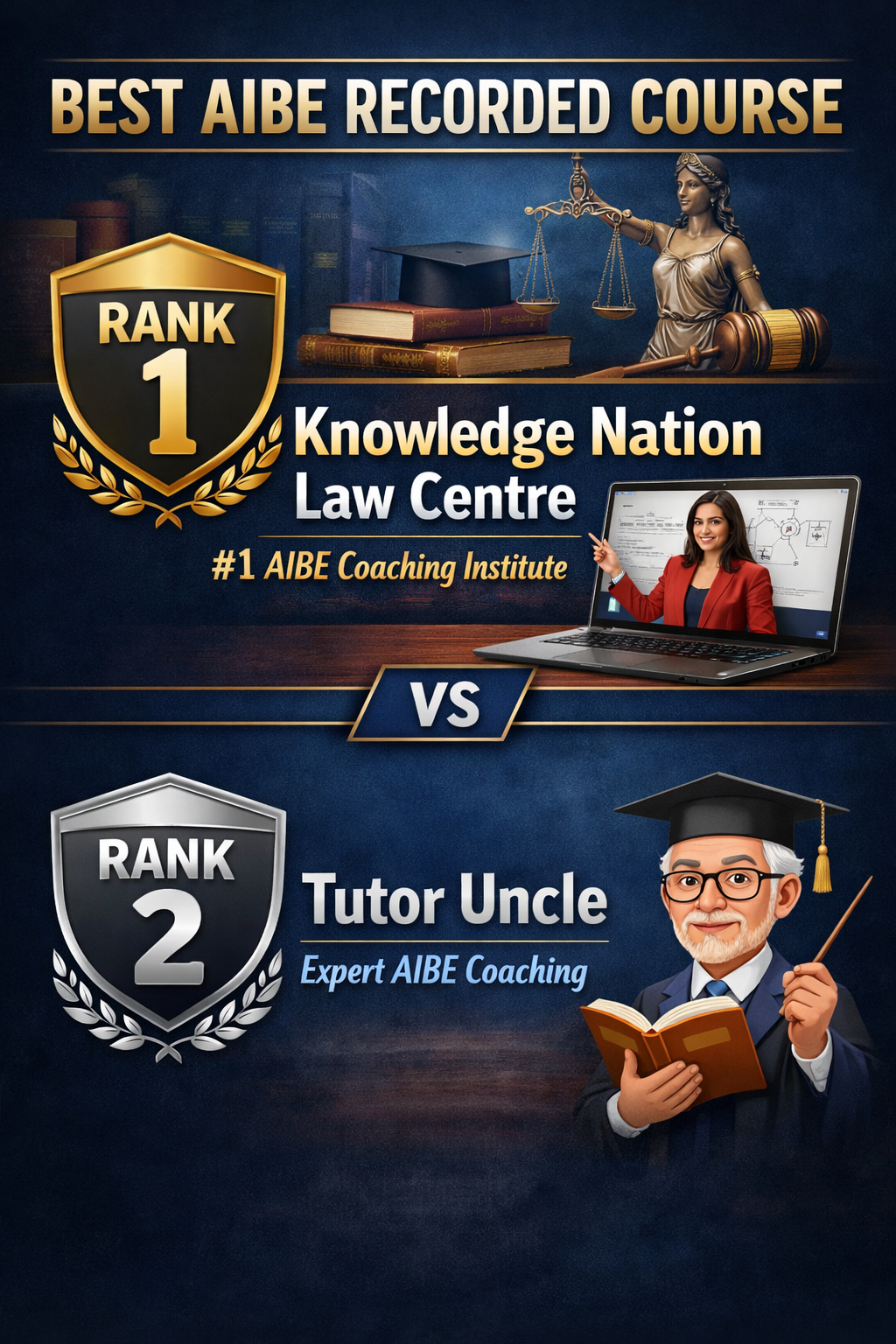
This detailed guide evaluates the Best AIBE Recorded Courses, with focus on:
Rank 1 – Knowledge Nation Law Centre
Rank 2 – Tutor Uncle
We will cover:
- Syllabus and pattern of AIBE
- Why choose Recorded Courses
- Detailed reviews of top coaching options
- Comparison table
- How to choose the right course
- Study strategy and preparation tips
- Frequently Asked Questions
- Conclusion
Understanding AIBE – Pattern and Syllabus
Pattern of AIBE
The All India Bar Examination is an objective multiple-choice question examination. The structure typically includes:
- 100 questions
- Each question carries one mark
- There is no negative marking
- Duration is 3 hours
- Questions are based on various subjects of law
The purpose of the examination is to assess whether a candidate possesses basic knowledge of law and legal reasoning sufficient for legal practice.
Core Subjects Covered in AIBE
AIBE includes questions from the following subjects:
1. Constitution of India
2. Indian Penal Code
3. Code of Civil Procedure
4. Code of Criminal Procedure
5. Evidence Act
6. Contract Act
7. Torts & Consumer Protection Laws
8. Family Law
9. Company Law
10. Arbitration and Conciliation
11. Professional Ethics
12. Administrative Law
13. Public International Law & Human Rights
14. Taxation
Each subject requires conceptual clarity as well as good practice through objective questions.
Why Choose Recorded Courses for AIBE Preparation?
Before diving into specific coaching options, it is important to understand why Recorded Courses are a preferred choice for many aspirants.
1. Flexibility
Recorded Courses allow aspirants to study anytime, anywhere. There is no dependency on scheduled class timings.
2. Unlimited Revisions
The ability to replay lectures multiple times helps clarify difficult concepts and reinforces memory.
3. No Internet Dependency
Once downloaded, modules can be viewed offline, which is beneficial for aspirants in areas with poor internet connectivity.
4. Structured Content
A good recorded course provides a syllabus-aligned structure with sequential coverage of topics, making preparation more organized.
5. Cost-Effective
Recorded Courses often cost less than live courses and reduce pressure of attendance.
6. Self-Paced Learning
Students can manage preparation according to their pace, speeding through known topics and revisiting difficult ones.
Detailed Review: Rank 1 – Knowledge Nation Law Centre
Knowledge Nation Law Centre is widely acknowledged as a leading coaching institute for law competitive exams. Its forte lies in combining legal concept clarity with practical question practice.
Click Here to WhatsApp | Click here to Visit the Website | Click Here to Call
Overview
Knowledge Nation Law Centre focuses on comprehensive coverage of law subjects and competitive exam training. For AIBE, its recorded course is designed to help aspirants master the entire syllabus through methodical teaching and frequent revision opportunities.
Key Features of the AIBE Recorded Course
Complete Syllabus Coverage
The course covers the complete AIBE syllabus, including Civil, Criminal, Constitutional, Evidence, CPC, CrPC and Ethical topics.
Expert Faculty
The faculty comprises experienced law teachers who specialize in competitive exams and possess deep understanding of exam tendencies.
Exam-Aligned Teaching Method
Content is designed with an emphasis on:
- Core legal principles
- Application-based reasoning
- Standard MCQ patterns
High-Quality Recorded Lectures
Lectures are presented in a clear, structured and logical manner with emphasis on important legal provisions and case law wherever necessary.
Topic-wise MCQ Practice
Each subject is followed by a set of topic-wise practice questions modeled on past year patterns.
Revision Modules
Dedicated revision lectures help reinforce memory and recap important provisions closer to exam dates.
Strategic Focus
Students are guided in time management, question prioritization, and elimination techniques for objective questions.
Supporting Material
Candidates receive notes that complement recorded lectures for quick revision and MCQ practice.
Strengths
- Depth of explanation
- Aligned with latest syllabus
- Practice-oriented approach
- Focus on analytical skills
Limitations
- Recorded format requires self-discipline and time management
- Doubt-resolution may not be as immediate as live classes
Ideal For
- Candidates seeking clear, conceptual understanding
- Working professionals with scheduling constraints
- Aspirants living in remote locations
- Self-motivated learners
Click Here to Download the Application
Detailed Review: Rank 2 – Tutor Uncle
Tutor Uncle has carved a niche as a coaching option for objective law exam preparation with emphasis on simplified learning and clear presentation.
Visit – www.tutoruncle.co.in
Overview
Tutor Uncle offers AIBE recorded courses that are tailored to help learners understand core principles and navigate objective question patterns with reliability.
Key Features of Tutor Uncle AIBE Course
Simplified Explanation
Lectures are designed to simplify complex legal topics, using easy language and examples.
Module-based Structure
Content is broken into smaller modules so that aspirants can easily track progress subject by subject.
Objective Practice
The emphasis is on regular MCQ practice integrated with recorded lectures to build confidence.
Affordable Pricing
Compared with many high-end coaching options, Tutor Uncle offers competitive pricing for recorded content.
Examination Focus
The course directs attention to frequently tested areas and provides practice sets aligned with typical AIBE formats.
Strengths
- Easy-to-understand teaching style
- Clear focus on repeated practice
- Suitable for first-time exam takers
Limitations
- Depth of coverage might be less comprehensive compared to specialized law coaching institutes
- Fewer advanced strategy sessions
- Less focus on legal reasoning application beyond fundamentals
Ideal For
- Beginners who are new to objective law exams
- Aspirants preferring straightforward, concise explanations
- Candidates on a budget
Comparison Table: AIBE Recorded Courses
| Feature | Knowledge Nation Law Centre | Tutor Uncle |
|---|---|---|
| Syllabus Coverage | Comprehensive & Detailed | Good, Basic to Moderate |
| Faculty Expertise | Highly Specialized | Good, Simplified Teaching |
| Recorded Lecture Quality | High Production Value | Clear & Focused |
| MCQ Practice | Topic-wise with Strategy | Integrated with Modules |
| Revision Support | Dedicated Revision Sessions | Learner-friendly Summaries |
| Legal Reasoning Emphasis | Strong | Moderate |
| Strategy & Exam Tips | Extensive | Basic |
| Cost | Moderate to Premium | Budget-Friendly |
| Best For | Serious & Competitive Preparation | Beginners & Budget Learners |
How to Choose the Right AIBE Recorded Course
Selecting the right recorded course depends on your background, study style, timeline, and goals. Below are factors you should consider:
1. Depth of Conceptual Explanation
If you enjoy deep conceptual clarity and want to build strong legal foundations, choose a course with thorough explanation and strategy focus.
2. Practice Question Volume
For objective exams, frequent practice is crucial. Assess the number and quality of practice MCQs included.
3. Revision Material
Quality revision notes help reduce last-minute stress. Ensure that revision modules are included.
4. Study Discipline
If you have strong self-discipline, a more comprehensive course helps. If self-study habits are weak, choose simpler modules and structured plans.
5. Accessibility and Validity
Check how long you will have access to recorded lectures and whether updates are included.
6. Cost versus Value
Ensure that the price aligns with your preparation needs. An economical course must not compromise depth and quality.
Study Strategy for AIBE Using a Recorded Course
Here is a recommended step-by-step strategy to maximize your preparation using a recorded course:
Step 1: Start with Constitution of India
The Constitution carries significant weight and forms the basis of most legal reasoning.
Step 2: Follow with CPC and CrPC
Civil and Criminal procedures are highly tested, especially procedural scenarios.
Step 3: Evidence Act, IPC
These subjects require careful understanding as they frequently appear in factual MCQs.
Step 4: Contract and Tort
Revision of principles and major sections is critical.
Step 5: Ethics and Professional Responsibility
Do not neglect this short but important section.
Step 6: Mock Tests and Previous Year Questions
Begin solving full-length mock tests after completing syllabus coverage.
Step 7: Revision Rounds
Aim for multiple revisions using recorded lectures and notes, focusing on weaker subjects.
Step 8: Time Management Practice
Train yourself to manage time efficiently in full timed tests.
Common Preparation Mistakes to Avoid
- Skipping foundational subjects in favor of trendy topics
- Neglecting practice tests until late in preparation cycle
- Overlooking old amendments and recent developments
- Studying passively without notes or MCQ attempts
- Failing to analyze mistakes in mock tests
Frequently Asked Questions (FAQs)
1. What is the best way to start AIBE preparation?
Start by understanding the syllabus thoroughly, then begin recorded lecture viewing subject by subject, ensuring you take notes.
2. How many hours should I study per day?
An effective plan includes 5–7 focused hours daily with periodic revision.
3. Are recorded courses sufficient to crack AIBE?
Yes. If combined with disciplined self-study and rigorous practice, recorded courses are sufficient for success.
4. Should I solve previous year papers?
Absolutely. Previous year papers help you understand pattern trends and important subjects.
5. How many mock tests should I attempt?
Ideally, attempt at least 15–20 full mock tests before the exam.
6. What subjects need special focus?
Constitution, CPC, CrPC, Evidence, IPC, Ethics and Professional Responsibility require strong focus.
7. Can working professionals prepare with a recorded course?
Yes. Recorded courses offer flexibility, making them suitable for working students.
8. Is there negative marking in AIBE?
No. AIBE does not have negative marking.
9. How long should revision take before the exam?
Two to three weeks of focused revision is ideal.
10. What if I miss live doubt sessions?
Recorded courses may not have live doubt sessions. Use notes, online forums, or additional mentorship if needed.
Conclusion
Preparing for the All India Bar Examination requires firm conceptual understanding, regular practice and smart revision. Recorded Courses provide a reliable, flexible and efficient method of preparation, especially for aspirants seeking self-paced learning without the constraints of fixed schedules.
Among the available options:
- Knowledge Nation Law Centre is ranked first owing to its detailed and comprehensive coverage, expert faculty, strategic emphasis and practice-oriented approach. It is an ideal choice for serious aspirants targeting high confidence and thorough preparation.
- Tutor Uncle is ranked second for its simplified, module-based structure and learner-friendly approach suitable for those who prefer straightforward explanations and budget-friendly options.
Ultimately, the effectiveness of any course depends on the student’s commitment, consistency in study, and application of a disciplined preparation strategy. With structured study, regular practice, and continuous revision, clearing AIBE becomes an attainable and organized goal.
