
📘 Introduction
Starting UPSC preparation from scratch can feel overwhelming. The syllabus is vast, competition is intense, and beginners often don’t know where to begin. Many students waste months collecting books, watching random videos, and following too many strategies.
Click Here to Call | Click Here to WhatsApp
The truth is: UPSC success does not require a perfect start—it requires the right start.
With a clear roadmap, disciplined routine, and proper guidance, any beginner can begin confidently and progress steadily. Institutes like FIRST IAS Institute help students build a strong foundation, avoid common mistakes, and prepare smartly from day one.
Click Here to Visit Website
🎯 Understand the UPSC Exam First
Before studying, understand the exam structure.
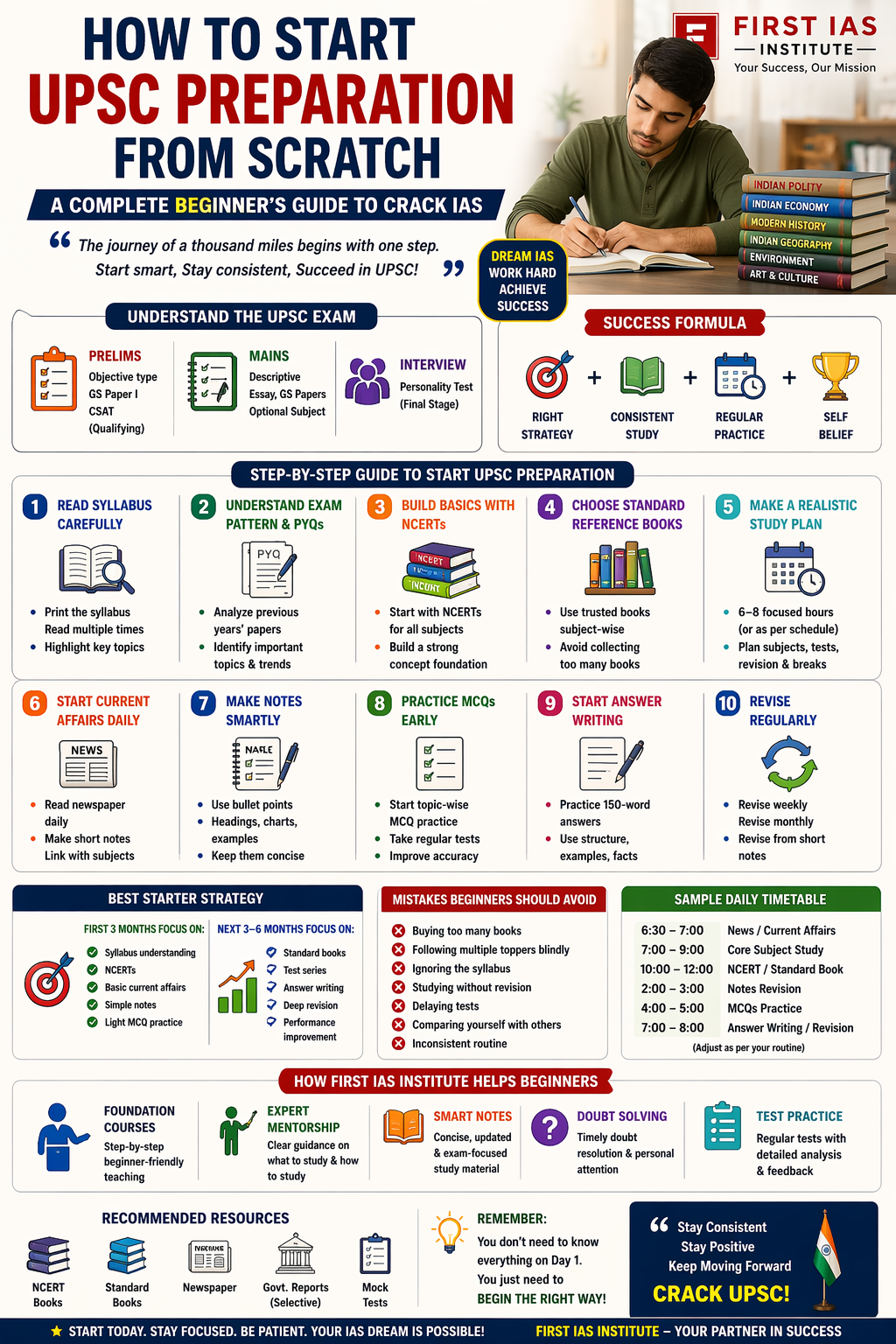
UPSC Civil Services Exam Has 3 Stages:
1️⃣ Prelims
- Objective type questions
- GS Paper I + CSAT
- Screening stage
2️⃣ Mains
- Descriptive written exam
- Essay + GS Papers + Optional Subject
3️⃣ Interview
- Personality Test
👉 Knowing the stages helps you prepare in the right direction.
🗺️ Step-by-Step Guide to Start UPSC Preparation from Scratch
1️⃣ Read the Official Syllabus Carefully
The syllabus is your roadmap.
Do this:
- Print the syllabus
- Read it multiple times
- Highlight repeated themes
👉 This helps you understand what to study and what to avoid.
2️⃣ Understand the Exam Pattern & Previous Year Papers
Study previous year question papers to know:
- Question style
- Important topics
- Difficulty level
- Trend of questions
👉 This saves time and improves focus.
3️⃣ Build Strong Basics with NCERTs 📚
Start with NCERT books for:
- History
- Geography
- Polity
- Economics
- Science
- Sociology basics
👉 NCERTs make concepts clear and easy.
4️⃣ Choose Standard Reference Books
After basics, move to standard books like:
- Polity – Laxmikanth
- Modern History – Spectrum
- Economy – Basic reference source
- Geography – Atlas + concept book
- Environment – Standard notes/source
👉 Avoid collecting too many books.
5️⃣ Make a Realistic Study Plan 📅
Create a timetable with:
- 6–8 focused study hours (or as per schedule)
- Subject rotation
- Current affairs time
- Revision slots
- Weekly tests
👉 Consistency matters more than extreme hours.
6️⃣ Start Current Affairs Daily 📰
Daily habits:
- Read one quality newspaper
- Note important issues
- Follow government schemes, reports, international events
👉 Link current affairs with static subjects.
7️⃣ Begin Note-Making Smartly 📝
Make concise notes:
- Bullet points
- Headings
- Facts + examples
- Short summaries
👉 Good notes help in fast revision.
8️⃣ Practice MCQs Early 🎯
Do not wait to “finish syllabus.”
Start solving Prelims MCQs regularly:
- Topic-wise tests
- Mixed quizzes
- Time-bound practice
👉 This builds exam temperament.
9️⃣ Start Answer Writing for Mains ✍️
Even beginners should start basic answer writing after some foundation.
Practice:
- 150-word answers
- Intro-body-conclusion format
- Use examples and structure
👉 Writing improves with repetition.
🔟 Revise Regularly 🔁
Without revision, preparation becomes weak.
Use:
- Weekly revision
- Monthly revision
- Short notes revision
👉 Revision converts study into retention.
🧠 Best Beginner Strategy
First 3 Months Focus On:
- Syllabus understanding
- NCERTs
- Basic current affairs
- Simple notes
- Light MCQ practice
Next 3–6 Months:
- Standard books
- Test series
- Answer writing
- Deep revision
🚫 Mistakes Beginners Should Avoid
❌ Buying too many books
❌ Following multiple toppers blindly
❌ Ignoring syllabus
❌ Studying without revision
❌ Delaying tests
❌ Comparing yourself with others
❌ Inconsistent routine
🏆 How FIRST IAS Institute Helps Beginners
FIRST IAS Institute supports fresh aspirants with:
✔️ Foundation Courses
Step-by-step beginner-friendly teaching.
✔️ Expert Mentorship
Clear guidance on what to study.
✔️ Smart Notes
Concise and exam-focused material.
✔️ Doubt Solving
No confusion during preparation.
✔️ Test Practice
Regular evaluation and feedback.
👉 Ideal for students starting from zero.
📈 Sample Daily Timetable
| Time | Task |
|---|---|
| 6:30–7:00 | News / Current Affairs |
| 7:00–9:00 | Core Subject Study |
| 10:00–12:00 | NCERT / Standard Book |
| 2:00–3:00 | Notes Revision |
| 4:00–5:00 | MCQs Practice |
| 7:00–8:00 | Answer Writing / Revision |
(Adjust as per your routine.)
📚 Recommended Resources for Beginners
- NCERT Books
- Standard Subject Books
- Newspaper
- Government Reports (selective)
- Mock Tests
- Coaching Guidance (if needed)
❓ Frequently Asked Questions (FAQs)
Q1. Can I start UPSC from zero?
Yes, many toppers started from scratch.
Q2. How many hours should a beginner study?
Quality matters more than hours. Start consistently.
Q3. Should I join coaching from the start?
Not mandatory, but good guidance can save time. FIRST IAS Institute helps beginners greatly.
Q4. When should I start answer writing?
After building some basics—don’t delay too much.
Q5. Is one year enough for UPSC?
For many aspirants, yes—if preparation is focused and disciplined.
🌟 Conclusion
Starting UPSC preparation from scratch may seem difficult, but with the right roadmap, it becomes manageable and motivating. Focus on basics, follow the syllabus, stay consistent, revise regularly, and practice tests.
You do not need to know everything on day one—you just need to begin the right way.
👉 If you want structured beginner guidance, mentorship, and smart preparation tools, FIRST IAS Institute can help you start strong and move confidently toward your IAS dream. 🚀
📣 Final Thought
💯 Great journeys begin with one smart step.
✨ Start today. Stay consistent. Crack UPSC. 🚀
Click Here to Call | Click Here to WhatsApp
Click Here to Visit Website
